

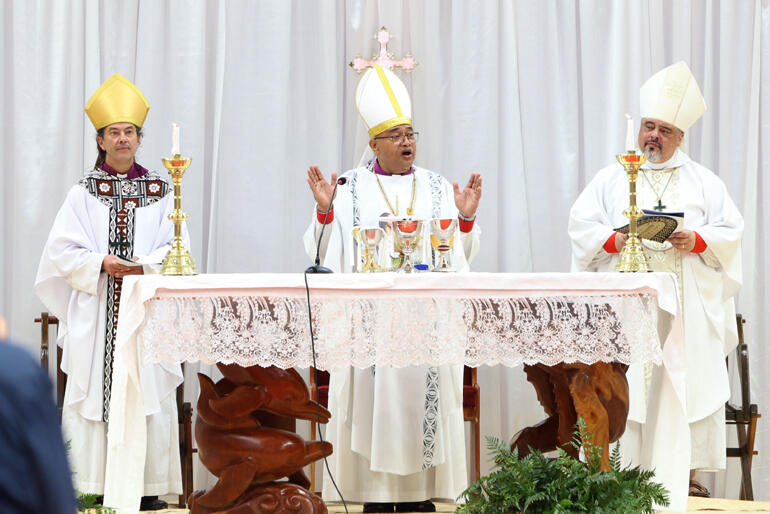
Primatial Charge for the 67th General Synod Te Hīnota Whānui
Mālō e lelei. Ni sa bula vinaka. Tālofa lava. Namaste. Tēnā koutou katoa. Grace and peace to you all in the name of our Risen Lord and Saviour, Jesus Christ.
For the first time, General Synod / Te Hīnota Whānui gathers in the Kingdom of Tonga. We offer our humble greetings to His Majesty King Tupou VI, to the Royal Household, and to the people of this ancient and storied Kingdom.
We give thanks to the Diocese of Polynesia, to the Episcopal Unit of Tonga, and to all whose manaakitanga, labour, and prayers have prepared the way for this hui.
To be welcomed as one family onto these shores is itself a proclamation of the Gospel. The generosity of Moana hospitality is a living sermon, and we receive it and give thanks to God with humble and grateful hearts.
We acknowledge all those who have gone before us – the faithful departed of this Church and the leaders whose vision carried us to this moment – and, in particular, we honour the memory of Archbishop Fereimi Cama.
We acknowledge the legacy of leadership provided by Archbishop Emeritus Winston Halapua and Archbishop Emeritus Philip Richardson, whose ministries continue to bear fruit among us.
We acknowledge His Majesty King Tupou VI, Her Majesty Queen Nanasipau’ u Tuku’aho, His Royal Highness Crown Prince Tupouto’a Ulukalala, Her Royal Highness Crown Princess Sinaitakala Tuku’aho, Her Royal Highness Princess Royal Salote Mafileʻo Pilolevu Tuita, Lord Tuita, Honorable Frederica Fatafehi Tuita, Honorable Fahina, Honorable Prime Minister Lord Fakafanua; Cardinal Soane Patita Paini Mafi of the Catholic Diocese of Tonga; Rev. Tevita Tonga Constitutional Church of Tonga; His Excellency High Commissioner Brody Sinclair of Aotearoa New Zealand; Rev. Ikani Tolu; General Secretary of the Tonga National Council of Churches, and the Lord Mayor of Palo Alto.
One Mission, One Ocean, One Vaka
Our theme for this General Synod / Te Hīnota Whānui is “One Mission, One Ocean, One Vaka.”
Two years ago, at the 66th Synod in Heretaunga, our charges traced a biblical journey from lamentation to hope – from the grief of Lamentations to the promise of Isaiah, from the affliction Paul describes in his second letter to the Corinthians to the treasure carried in jars of clay (2 Corinthians 4:7–18). We named the wounds inflicted on our people and on creation: Cyclone Gabrielle, the floods in Fiji and Tonga, and the mounting toll of a changing climate on the moana that gives us life.
This Synod, we take the next step on that journey. Hope, if it is real, must set sail. It must leave the shore. The vaka is hope made seaworthy.
Our tīpuna, the great navigators of the Pacific, did not cross the largest ocean on Earth by accident. They read the stars, the swells, the flight of birds. They built vessels equal to the deep, provisioned them for the voyage, and entrusted themselves and each other to the moana. No one crosses the moana alone. Every soul aboard the vaka depends on every other – the navigator, the keeper of prayer, the crew, those who rig and trim the sails, those who provide kai and manaakitanga by day, and those who watch through the night.
So, it is with our Church. When Jesus called his first disciples, he called them from their boats, and then he got into the boat with them. When the storm rose on Galilee and the disciples cried out in fear, he was in the vessel with them, and at his word the wind and the waves were calmed (Mark 4:35–41). When he told Simon Peter to "put out into the deep water and let down your nets" (Luke 5:4), the catch that followed was so great that one boat could not hold it. They had to signal their partners in the other boat to come and help. If we are prepared to leave the shores of our status quo, and to cast our nets into the deep, we will find the greatness of God’s abundance. And the abundance of God is always too great for just one tikanga, just one island, just one generation. Abundance demands that all participate, and all share in the mission and manaakitanga.
One Mission
The mission is not ours; it is God's. We are invited aboard. Our Missio Dei – to proclaim the good news, to teach and nurture, to respond to human need in loving service, to seek to transform unjust structures, and to safeguard the integrity of creation – must become our Actio Dei. Our proclaimed mission and our actions must align. Ours is the one voyage on which every ministry of this Church is embarked.
This Synod will consider many matters: justice, equity and resourcing, the way we disciple and teach, legislation, budgets, reports, elections. Let us test each one against a single question: Will this help the vaka sail the moana on God's mission? Structures, like hulls, exist to carry something. When they no longer serve the voyage, we repair or we replace. But we do not mistake the vessel for the destination.
One Ocean
The moana is not an empty space between us; it is the living water that joins us. We are not scattered isolated silos living only for ourselves. We are a sea of islands, made one by the moana. The waters of the moana are not a barrier that keeps from each other, but as in the times of our ancestors and forebears, the moana is a mighty highway that keeps us connected and makes us one. Ours is a vast blue continent, full of abundant life, and worthy of honour, dignity, and respect.
What has been said in recent years we say again with greater urgency: our Moana is both Water of Life and Water of Hope, and its health is the health of the world. Rising seas do not respect diocesan boundaries. The communities of Tonga, Fiji, Samoa, Aotearoa and the wider Pacific stand on the frontlines of a climate crisis they have done the least to cause. The whole Church, in all three Tikanga, is called to stand together in advocacy, in adaptation, and in the patient, practical work of the kaitiakitanga and stewardship of communities and creation, and in refusing the cynicism, apathy, and despair that says nothing can be done.
To grieve is to love. To lament is faithful. To stop at lament is not. The journey from lamentation to hope, which helps to frame our moana talanoa, must now become a journey from hope to action.
One Vaka
We are a three Tikanga Church. Te Pouhere is not merely a legal settlement. It is a theological confession and proclamation that unity in Christ does not erase difference but sanctifies it. Te Pouhere sets us as co-equal. Ours is to honour that commitment as sacred, and to refuse its diminishment. Tikanga Māori, Tikanga Pākehā, and Tikanga Pasefika are not three vaka sailing in loose formation. We are one vaka, and the vaka cannot sail safely without the cohesion of those on board.
There may be moments in this Synod when we disagree. Let us disagree as people who share one vaka, and who know that the safety, wellbeing, and thriving of each depends on the seaworthiness of the whole.
The Most Reverend Dr Don Tamihere
Te Oranga Ake
Anō te pai, anō te ahuareka o te nohoanga a ngā teina, o ngā tuākana ii runga ii te whakaaro kotahi … i whakahaua iho hoki e Ihowā te manaaki mō reira, te ora mō ake tonu atu.
How wonderful, how blessed when we dwell in unity … for there the Lord commands a blessing, even life evermore. (Ngā Waiata 133:1,3b)
What a wonderous blessing it is to dwell here, with our tuākana teina from Tikanga Pasefika and Tikanga Pākehā, as manuhiri of Archbishop Sione and the Diocese of Polynesia in the Kingdom of Tonga.
In Te Ao Māori we speak of our ancestral origins, and the eventual destination of our ancestral spirit, as Hawaiki nui, Hawaiki roa, Hawaiki pāmamao – encompassing all of the Polynesian triangle and beyond to the edges of the great blue continent that we call Te Moana-nui-a-Kiwa. These precious ancestral connections, along with the stories and traditions of our ocean-traversing waka, their wayfinding kaihautū priests and crew, have been kept vibrant and alive within Māori oral tradition for centuries.
It gives us great joy to be able to retrace and enliven those ancient pathways, to connect and reconnect with our brothers and sisters in the Moana. Our shared whakapapa and whakapono remind us that we must orient ourselves towards the horizons between us, traverse them, and find one another, because in each other we discover our true selves. Such is the design of the Creator God.
Within Te Pīhopatanga o Aotearoa, our vision and our purpose is Te Oranga Ake – the flourishing of the Hāhi, of our whānau and communities, and of all creation as the Gospel imagines. It is our translation into action of the challenge and promise of Jesus: “The thief comes but to steal, to kill, and to destroy. But I have come that they may have life and have it abundantly” (John 10:10).
We believe that we are called to do all that we can to liberate ourselves and each other from the domain of the thief and move insistently towards the Oranga Ake that Christ promised. We get there through a wānanga of aroha, a wānanga of rongo, and a wānanga of hari – a wānanga of Te Rangatiratanga o Te Rangi. We choose to say “No!” to that which steals, kills, and destroys. We choose to move towards life, and life abundantly.
“Te Oranga Ake” began simply enough as a phrase. It was our attempt to give language to a growing idea of what our Mihinare purpose could and should be, our raison d’etre, our why, our kaupapa matua. Then the wānanga began. Very soon it became the language of our visioning. Not long after, we realised that it was also the language of our liberation, and the work – the hard work – of setting the foundations for future flourishing.
So, Te Oranga Ake is the measure against which we are learning to test everything we do: Is this life-giving? Does this heal what has been hurt? Does this restore what was diminished? Will this set the preconditions for our healing? Will this set the foundations for our future flourishing?
Within Tikanga Māori we see promising signs of life and flourishing, simply because we have reoriented ourselves towards better faith horizons.
We see Te Oranga Ake in the Te Takawai and Toi Amorangi programmes, raised up and sustained through ngā Hui Amorangi in partnership with St John's Theological College, forming a new generation of ministers grounded in te reo, in tikanga, and in the deep wells of our whakapapa and whakapono.
We see Te Oranga Ake in the Anglican Indigenous Leadership Initiative (AILI), a solidarity of indigenous Anglican leadership bound together not by structures or statutes, but on whanaungatanga, deep friendship, and a genuine love and care for each other.
From that whanaungatanga flows solidarities that are reshaping what mission looks like for us: a lived care for creation, a real transformation of unjust structures, decolonising Christianity and indigenising theological education and ministry formation, walking in shared discipleship and leadership development, and standing with each other, declaring our love for each other through presence and servanthood.
What we could not, and cannot do alone, we choose to do together – Indigenous Anglicans navigating by shared stars.
We see Te Oranga Ake in the renewed and continuing elevation of authentic indigenous women leaders – not as concession or token, but as the restoration of a balance our tīpuna understood and that the Gospel demands. Where wāhine are free to express their true mana and sacredness, the whole people of God flourishes.
We see Te Oranga Ake in Manuika, our rangatahi discipleship kaupapa, which takes the ancient art of wayfaring – the traversal of the Moana by reading the stars, swells, and winds – and makes it a platform for indigenous discipleship.
Our rangatahi are learning to navigate the Moana and to navigate life in Christ in the same breath, and they are discovering that these were never two separate journeys.
We see Te Oranga Ake in the ongoing renewal of mātauranga Mihinare, which is the recovery and reorientation of our own cultural and theological inheritance, a reclamation of our own story, and an insistence that ours is a whakapapa and a whakapono worthy of its own place in the global academy.
We see in the combined efforts of our Mihinare whānau and friends the emergence of new life – and tantalising proof that reorienting ourselves towards the horizons of Te Oranga Ake will lead to the liberation and abundant life that Christ taught and our ancestors hoped for.
But these faith horizons will not come to us, no matter how long we stand dreaming on the shore. We must board the waka, navigate the Moana, and strive to reach them. There’s work to do.
Part of our work this Synod will be to engage in shared talanoa and wānanga to address that which constrains, and obstructs, and frustrates our collective liberation. For over three decades, Te Pouhere – our Constitution, has promised that our three Tikanga stand as co-equal partners: each with the unmediated mana to order its own life, each honoured, none subordinate. That promise was itself an act of repentance and hope, and we do not diminish it.
But a promise written is not yet a promise kept. The lived reality is that Tikanga Māori and Tikanga Pasefika remain systemically marginalised within our shared life – in the distribution of resources, in the weight of our voices, in the assumptions about whose ways of being are ‘normal’ and whose ways require accommodation first. These are truths that we must name, if only that we might leave them behind.
The challenge of Te Oranga Ake is to ask ourselves, “What kind of Church are we?”, and “What kind of Church do we want to be?”
Are we a Church where one part says to the other, “We own this, but you do not”; or “This is ours, and not yours”; or “We don’t want you to have what you need?”
The Te Oranga Ake view would hope that we would not be resentful of releasing each other to flourishing. We share with those we love.
The Te Oranga Ake view also knows that our hope, our healing, and our flourishing remain inexorably bound in each other.
We are proud as Tikanga Māori to share the same waka and the same Moana as Tikanga Pasefika and Tikanga Pākehā. We want to see Te Oranga Ake realised for each of us, and therefore for all of us, together, none excluded, everyone included.
We hope that by the end of this Synod we can renew a shared commitment to One Vaka, One Moana, and One Mission.
The Most Reverend Justin Duckworth
I too extend my greetings and my gratitude to our hosts, His Majesty the King, to the Diocese of Polynesia, to the land on which we gather today and the moana we rest within, and to all those who have worked so hard to make this Synod possible.
And thank you Archbishop Don for your reflection. As we come to centre our time as a Synod around the three themes of One Mission, One Ocean, One Vaka, I do so conscious of the joy of our interconnectedness as the people of Jesus, drawn together in our Mihinare expression by the moana.
It’s good to be together. I feel like I say this so often, simply because we live in a time of unprecedented geopolitical, economic, cultural, social, psychological and environmental upheaval. This global upheaval we also feel locally in so many ways. I imagine every person in this room can speak to the effects of this instability on the communities they serve. We find ourselves at an extremely challenging time in history. We need each other.
I don’t know about you, but in this instability, I also see a greater openness to the hope that the gospel offers. Almost every congregation I visit, or follower of Jesus I spend time talking to, can attest to a scent of hope on the incoming breeze. This looks like unknown people turning up at the church door confessing that “they don’t know why they’re here, but they just felt they should come”. It looks like young people reclaiming the inheritance of faith passed on by their elders and making fresh commitments to follow Jesus.
In noticing that scent of hope, as Archbishop, I also find it deeply challenging that on the ground, those who engage at grassroots with our expressions of Church are not particularly interested in the fact that we are part of this Province, this system, this structure. Not because that disinterest isn’t right – it absolutely is – they should not be attracted foremost to the Anglican Church.
They should be attracted to Jesus. For me the challenge comes because I wonder whether we in this room spend too much time enmeshed in the system and structure that has been created.
For those of us who are decision-makers, the challenge is whether we as a General Synod, as senior leaders, as a Province and as Tikanga, are signs of the Kingdom for those who are looking for it.
A question we must continually wrestle with is whether we are being healthily available to the communities we inhabit, or if are we caught and dying in a net of our own dynamics? Are we too dysfunctional to cope with the opportunities the world is throwing at us? As we gather this week, let’s not lose sight of the reality that everything we do serves to help the grassroots flourish and to help the Kingdom of God be present in every corner of the Pacific.
Our challenge and opportunity in this season lies in our relationship with each other, aboard this single vaka that we cherish. We are people who live in the legacy of colonialism, of Te Tiriti, of Te Pouhere, and we need to work out what these and other things mean now. But let’s not be paralysed by the fear of what the past means in the present and allow that fear to stop us from moving forward.
Past and present coexisting is not a zero-sum game. We can be people who acknowledge our past and who are mature enough to make sure our vaka is seaworthy for the present. And we can also be mature enough that even if we haven’t got it all worked out, we can still get on with the business of pointing people towards the resurrected Jesus, the Master Navigator and the Guiding Star.
I’ve been reflecting that when, in Matthew 14, we read that Jesus walked on water and invited Peter to join him, he didn’t stop the wind and the waves before he invited Peter out of the boat. Jesus seems to have been less interested in the plight of the boat (and perhaps even the disciples within it) than in the demonstration of his power to trample on the chaos of the deep, to point towards the resurrection to come, and his ability to call Peter beyond what he could imagine was possible.
To be smart and seaworthy leaders in this time means continually navigating the tension between the two. In what ways are we prioritising the vaka over pointing people to take the hand of the resurrected Jesus?
It’s good that we cherish this Province, our vaka – it is a gift from God. It’s good that we love and care for our diverse crew - we want our vaka to be seaworthy and we want to be able to steer it well together. We have chosen this vaka, and we’ve chosen to be in it together. We must not confuse the vaka with the destination.
Friends, this is a challenge, but it’s such a good one. It’s good to be together in mutual belonging to each other and to our Creator whose banner, whose sail over us, is Love. As we gather in harbour, let us pray for the Spirit’s refreshment and provision in every way, so that we can love each other well, confront our reality, and be empowered to share the hope we have in every place we inhabit with wisdom, generosity and joy.
The Most Reverend Sione Ulu’ilakepa
I give thanks to God with a full heart that General Synod / Te Hīnota Whānui is gathered here in the Kingdom of Tonga.
This is more than the hosting of a meeting. It is a sign of grace. It tells the whole Church that Tikanga Pasefika is not at the margins of our common life. It tells our people here in Tonga that their faith, their witness, and their place in this three-Tikanga Church are seen, honoured, and cherished.
It is fitting that we gather in the Kingdom of Tonga as it celebrates the bicentenary of the arrival of Christianity. Two hundred years ago, the Gospel came ashore in these islands and took root in the lives of our people. Since then, the Christian faith has shaped this nation—our public life, our hopes, our griefs, and our identity.
We give thanks for those who first received the Gospel, for those who endured for it, and for those who handed it on faithfully to the generations that followed. This bicentenary is not only a memory of the past. It is a time for gratitude, humility, and renewal before God.
Within that wider Christian story, the Anglican presence in Tonga has been small in number, but precious in witness. God has sustained the Church here with patience and mercy and has woven it into the wider life of the Diocese of Polynesia and the Anglican Church of Aotearoa New Zealand and Polynesia.
Our witness does not rest on size or influence, but on faithfulness, service, and belonging. To receive General Synod here in this bicentenary year is an honour for Tonga. It is also a testimony to the grace of our shared life. The Moana does not separate us. By God’s mercy, it carries us toward one another.
So, beloved, I believe this Synod must hear a particular word from the Kingdom of Tonga: let us give thanks for the past, but let us not live in the past.
The God who met our ancestors is calling us still. The Christ who calmed the storm is still in the vaka. The Holy Spirit who planted faith in these islands is still hovering across the waters.
This bicentenary is therefore not only a celebration. It is a calling. We are not gathered simply to remember where the Church has been, but to discern where God is sending us next.
If we truly believe that we are one mission, one ocean, one vaka, then we must be ready to sail beyond memory into being together. We must ask what being together looks like now—for our young people, for our families, for those facing migration and economic hardship, for communities living with rising seas, and for a generation searching for hope. What does being together mean when we see inequity, inequality, and abuse of privilege in our societies and in our Church?
My prayer is that this Synod we’ll leave Tonga with more than minutes, resolutions, and reports. I pray that we will leave with a deeper love for one another, a renewed commitment to Te Pouhere, and a fresh courage for mission.
Let this gathering strengthen our common life, so that no Tikanga feels unseen, unheard, or left to carry its burdens alone. Let it deepen our responsibility to the Moana Nui a Kiwa, whose cries are now the cries of climate-vulnerable peoples across the Moana. Let it give us the wisdom to share our resources justly, and the courage to speak the Gospel into a wounded and anxious world.
My brothers and sisters, the Church is most truly herself when she trusts God enough to be put out into deep water; to rig the sails and set the course. So let us honour the faith of those who came before us, not only by remembering them, but by asking what the Lord requires of us today.
In this bicentenary season, may God make us more faithful in mission, more courageous in discipleship, more just in our life together, and more steadfast in our care for creation. May we leave these shores with renewed love for one another, renewed commitment to our common life, and renewed faith in the One who still commands the wind and the waves and still leads his Church forward.
The Call
Members of the 67th General Synod / Te Hīnota Whānui: the vaka is provisioned, the tide is right, and the One who commands the wind and the waves is aboard.
We in humility therefore charge you:
To keep to the one mission. Let every debate, every canon, every resource be weighed against the mission of God. What advances it, strengthen. What obstructs it, have the courage to change.
To care for the one moana. Commit this Church afresh to the healing of the whole moana community – in the practices of our parishes and schools, in the stewardship of our lands and investments, and in our public voice for climate justice, so that the communities of the Pacific are not left to face the rising waters alone.
To hold fast together as one vaka. Be kaitiaki of the unity of our three Tikanga Church, not as an arrangement to be managed but as a sacred gift to be treasured, and a sign to a divided world that difference, held in love, is strength.
And to do all of this in a united faith, a united hope, and a united action for true flourishing. Not with a shallow optimism that denies the storm, but with the deep belief in a resurrection life lived now – knowing that the One who was raised from the dead goes ahead of us across the water, and that no wave or wind is greater than his word.
Let us cast away from the shallow waters of the status quo and follow the call out into the deep blue of the moana – that we might traverse the horizon and find God in each other.
May God our blessed and sacred navigator bless this Synod, this Kingdom, this Church, and the moana that unites us all.
Amen.








Comments
Log in or create a user account to comment.