

Religious denominations are decidedly unfashionable these days. It used to be a social cachet to be an Anglican, a mark of normality , however inaccurate, compared to Roman Catholics who were different, left footed even.
Nobody cares anymore. Any sort of church going is odd and the most popular brands are “non denominational”. Even that term is fading away as the old brands get forgotten. My local church is attended by as many rebranded as original Anglicans.
I spent most of my life promoting the cause of ecumenism. Which doesn’t mean dissolving denominations. It’s more about gathering the best features of all of them and working in collaboration not competition. But it all ended in tears. Unlike Australia, the wheels fell off here with the still born Uniting Church of NZ. Ecumenism continues, but informally, spontaneously, in spite of the rules.
Call me quaint, but I believe more than ever in the values of the Anglican tradition. I think they position us well to display the Gospel to a country hungry for meaning and direction and increasingly confused about enduring values. Here are the things that keep me committed as an ecumenical Anglican; the mooring posts that keep me anchored to faith.
The liturgy for a start. Words and music, honed and polished by centuries, that evoke rather than prescribe. Anglicans play footloose with the prayer book these days but it still provides a structure and template for public worship that sustains us through seasons of theology and piety that come and go. What it does for me each Sunday is jolt me out of my personal prayers into a wider, richer framework of believing. And in times of grief and crisis it gives me “meet, right and proper” words to say, that I could never find alone. Words that let me pray without blaming, or caricaturing, or self promoting. Words that are inclusive and able to be owned by all sorts and conditions of people, without undue repetition, excess, sentimentality or hype.
Incarnation is the first hallmark of Anglican theology. Not salvation but an understanding of God embedded in our humanity and the whole creation. It’s a grounded faith, as Judaism is, not focused on me or some other place far away and long ago, but on the world around me as it is, right now.
I thought I knew that, but when our prayer book arrived in 1989 with the Benedicte Aotearoa asking rabbits and cattle, moths and dogs to praise God, incarnation took on new depth. When grounded in New Zealand’s soil, liturgy connects you to a God who is right here and now, faithful and sure footed as a musterer’s horse, as Otago Old Testament scholar Maurice Andrew loves to say. He’s a Presbyterian, that’s true, which just goes to keep us ecumenical.
The new psalm reconnected us with a theology of creation, so easily lost in personal piety, so easily shelved by legislation that begs responsibility for climate change. And a theology that honours the Creator God lets us embrace the bicultural treasures waiting to be discovered with festivals like Matariki.
One more mooring post, quite literally, is Te Pouhere, the ground breaking constitution we adopted for our church in 1992, anchoring us in the three tikanga of Māori, Pākehā, and Pasifica. It’s a governance structure that New Zealand looked at briefly then ran away from, but will one day have to revisit, hopefully before the bicenntenial of Te Tiriti in 2040.
Our future as a country is inescapably bicultural and multicultural, so it’s good to be part of a church that is already so. We’ve achieved that at a national level, but still trying to work it out locally.
That depends on developing respectful engagement with our tikanga partners. Developing skills in the use of te reo in the liturgy might feel like tokenism in an all Pākehā congregation but it makes a statement about where we belong.
Anglicanism has always claimed to be a broad church; able to hold together very different theologies. That capacity is being tested like never before at an international level with breakaway movements like Gafcon (The Global Anglican Future Conference). But New Zealand still holds all the Anglican dioceses and hui amorangi together in one synod. Embracing difference is an Anglican hallmark. We walk a middle road and balance on a three legged stool held up by reason, tradition and Scripture . Things get wobbly when one or other leg is neglected.
In the preface to the first English Prayer Book, written in 1662, this middle road is elegantly phrased. “It hath been the wisdom of the Church of England..to keep the mean between the two extremes, of too much stiffness in refusing, and of too much easiness in admitting any variation from it.”
Imagine a political party adopting those words in their manifesto. Especially the ones that indulge in racist and anti - immigrant rhetoric. Church for Anglicans is not like belonging to a club; a Rotary or Lions with Jesus added for good measure. There are no conditions for joining, no minimum attendance records, no joining fees, no platinum or gold memberships. A Victorian era habit in some wealthy communities tried a reserved pew system but happily it didn’t last.
Some denominations take membership very seriously and separate out members from mere adherents by signing up to confessions of faith and doctrinal allegiance.
Anglicans don’t. Ours is a tradition of being a church for all the people regardless of how much or little they believe; a comprehensive church that includes all shades of grey as well as black and white.
Anglicanism is the easiest church to belong to and the easiest to leave. Belonging, however loosely, always comes before believing. It’s a church with some clear and hard convictions about a trinitarian God at its centre but around the edges it’s soft, even mushy.
Such inclusiveness is important like never before in these times of narrowing allegiances. Many of our political leaders are linked to religious groups defined by inward focused and dogmatic doctrines of atonement, patriarchy and sexuality.
Anglican tradition is always outward facing. Archbishop William Temple once said Anglicanism is the only church that exists for the sake of those who don’t belong to it. The interests of those who attend are always secondary to serving those who don’t. There are of course other churches that do as much social service as Anglicans but none are as unfussed about brand boundaries and loyalties.
And when Anglicans do try to enforce rules about who’s in and who’s out, they usually make a mess of it. Witness the first Lambeth Conference that tried to call Bishop Colenso to task and inspired a comic opera instead. That ranks with the New Zealand Anglican bishops first effort at excommunication.
Aimed at the prophet T.W.Ratana, for preaching a theology that gave much space to angels, the edict alienated many Māori for generations.
More recently, the attempts by successive synods to ban, then only partially recognise the ministries and marriages of gay people, with insulting caveats, continues to be a source of public embarrassment for a church in a country where homosexual law was reformed half a century ago and the Topp Twins are national heroines.
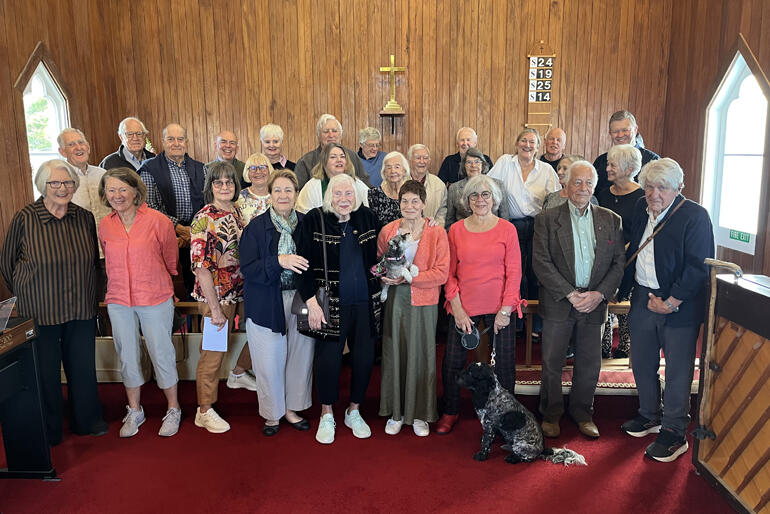
We do have rules (they are called canons , designed to guide rather than shoot people) to ensure decisions are made in orderly and consistent ways. And there are faculties required to move or add church furniture. ( Locally, we had to wait for one to move in a piano!) But they don’t determine who is in and out of thecommunity that gathers for worship.
And it’s that freedom that allows each Anglican congregation to embrace and welcome the most amazing mix of people; like and unlike-minded, the very fit and the very fragile, the very blessed and the broken hearted, the success stories and those who’ve lived fractured lives, some heroes and some cowardy custards.
Yet they are all able to gather and meet without judgement, or rank or privilege. And they come Sunday by Sunday with empty hands, knowing they will be filled, and with uncertain lives, knowing they’ll find food for their journey, richer than anything we can imagine or desire.
John Bluck is a retired bishop of Waiapu. A longer version of this reflection, entitled “Who wants to be an Anglican” can be downloaded from his website www.johnbluck.nz










Comments
Log in or create a user account to comment.