

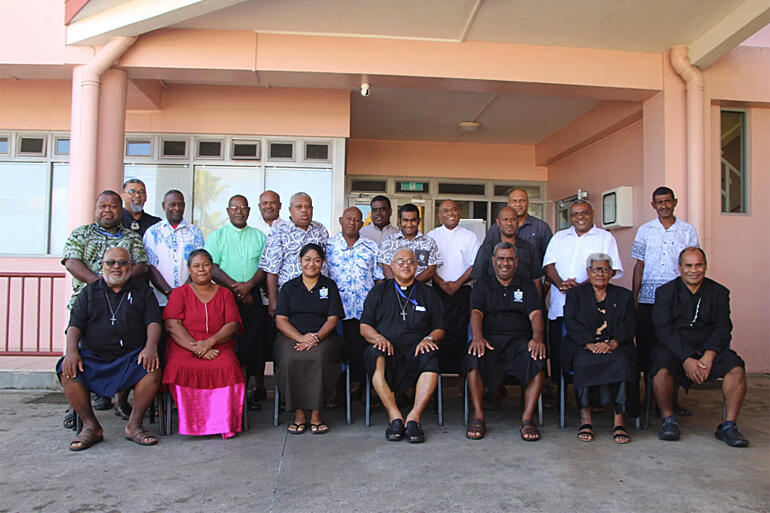
The Anglican Diocese of Polynesia has formally inaugurated the Melanesian Commission, setting before the Church and the wider community a solemn and hopeful commitment to the renewal of Melanesian life, dignity and future within the Diocese.
Rooted in the movement from the old and painful narrative of “forgotten people” toward the Gospel promise of becoming “people of God’s promise,” the Commission is established as a strategic and pastoral instrument for truth-telling, justice, reconciliation and practical transformation.
Grounded in the Five Marks of Mission, the Commission will direct the Anglican Church's work responding to the urgent issues confronting Melanesian communities, including: land insecurity, poverty, education, youth employment, substance abuse, cultural erasure and the enduring wounds left by colonial history.
Through the Commission the Diocese of Polynesia affirms that the mission of Christ in Fiji must be expressed in loving service, courageous advocacy and the restoration of human dignity to all.
Primate of the Anglican Church of Melanesia, Archbishop Leonard Dawea has accepted the Diocese of Polynesia's invitation to chair the Commission. Through this partnership, the Commission seeks to address the injustices of colonialism with honesty and Christian resolve, while helping to build a future of hope for the descendants of the Blackbird Trade.
Archbishop Sione Uluilakepa says the Melanesian Commission will be a spiritual and moral undertaking for the life of the Church, as well as a decision-making body driving ministry and mission.
“We are bringing our people together on a common foundation to confront the wounds left by colonialism, to honour the dignity of the descendants of the Blackbird Trade, and to build, with God’s help, a future shaped not by abandonment, but by promise.”
At the heart of the Commission’s framework is a theology of presence, humility and sacrificial service. The Commission's work will be to sit with communities, to listen before leading, and to understand the pain at its roots before attempting to speak into it.
This spirit is echoed throughout the strategy, which insists that renewal must begin with talanoa, patient accompaniment and a deep attentiveness to people, land, memory and place.
The strategic framework of the Commission is organised around six principal areas of work: - Land Rights and Advocacy;
- Consultation and Community Engagement;
- Education and Capacity Building;
- Cultural and Historical Recognition;
- Church and Government Relationships; and
- Communication and Awareness.
These six areas will operate alongside a broader poverty-alleviation strategy, reflecting the Diocese’s recognition that poverty makes communities vulnerable to hardships such as displacement, youth marginalisation and substance abuse.
The Commission will prioritise the issue of land, which the Diocese recognises as inseparable from belonging, security and intergenerational wellbeing.
The framework calls for lease audits, land-rights documentation, formal relationship-building with iTaukei landowners, and legal and administrative measures to secure Melanesian Anglican settlements for the future.
Alongside this, the Commission proposes a substantial investment in education and youth development, including vocational training, scholarship support, cultural identity formation and employment pathways, so that the next generation will have enhanced opportunities and vocational options.
The Commission also gives clear attention to healing the historical and spiritual wounds borne by Melanesian communities. The Diocese seeks to replace narratives of silence, exclusion and victimhood with a new language of remembrance, restoration and promise. The intention is not to deny suffering, but to bring it into the light of truth and to lead beyond it in hope.
To ensure faithful implementation, the framework establishes a clear structure of accountability through the Melanesian Commission, a diocesan implementation team, and settlement-level leadership bodies involving trustees, elders, youth and women’s representatives.
Over a two-year roadmap, the Diocese will focus first on foundations through audit, mapping, formalisation and partnership-building and then on renewal, through the launch of vocational programmes, cultural initiatives, poverty alleviation measures, expanded drug-prevention efforts and heritage documentation.
The Commission’s work will be measured not only by plans adopted, but by lives strengthened, communities secured, voices heard and hope made visible.
In inaugurating the Melanesian Commission, the Anglican Diocese of Polynesia declares anew its intention to walk with Melanesian communities in the way of Christ: with repentance where there has been failure, with courage where there has been injustice, and with hope where generations have long carried pain.
The Commission stands as a sign of the Church’s resolve that the descendants of the Blackbird Trade shall not be defined by neglect or dispossession, but by dignity, promise and a future held in the grace of God.












Comments
Log in or create a user account to comment.