

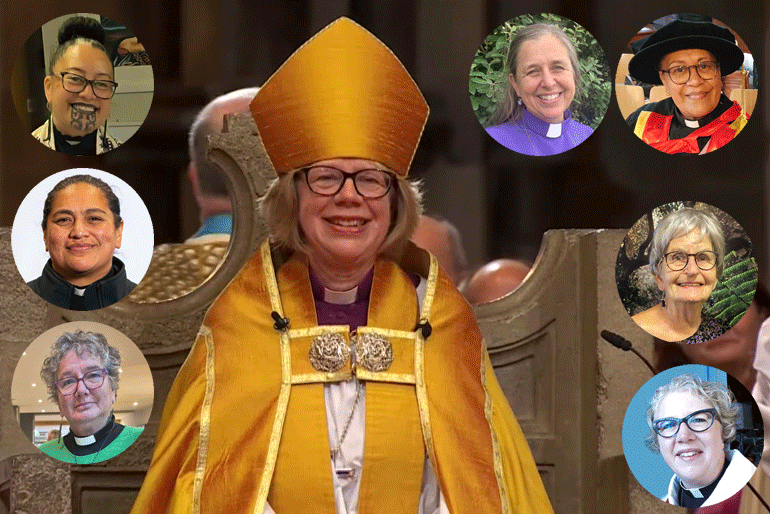
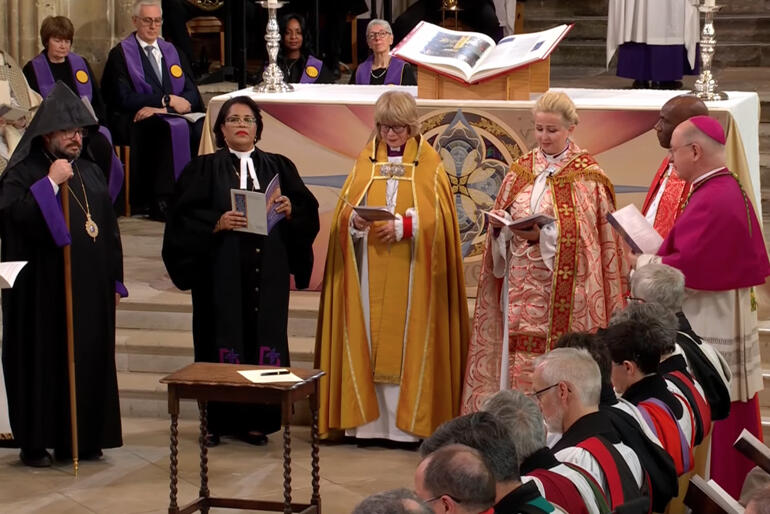
Archbishop Sarah Mullally's festal evensong and installation today could be read like a liturgical testament to her vision of centring women and building up a wider vision of inclusion.
From the two women who unbolted the Cathedral doors to let her in, to the five African Anglican female bishops attending (while so many men stayed away), and the female presidents of ecumenical coalitions that welcomed her on behalf of the wider church, the liturgy recognised and celebrated not only her own leadership, but many other women's.
Before her installation, Archbishop Sarah told a SkyNews reporter she is thankful for the many women who have supported her Christian vocation, which for her includes her nursing and health administration careers.
She hopes not only women and girls, but all people who watched her overcoming the odds to be installed today will be able to imagine a different future for themselves too.
"I want them to look at me and see it's entirely possible for you to be able to follow your dreams of what you want to do." she said.
The Rev Wendy Scott has been in Canterbury UK for the enthronement, as a representative of the global Anglican Consultative Council (ACC) Standing Committee.
"What a privilege to have a front row seat to history being made in the church I love and serve." said Wendy.
As a former nurse and now priest, Wendy sees valuable skills and qualities developed through nursing that Archbishop Sarah brings to her new role.
"[As a nurse]..having a deep sense of compassion for those in need, being able to pivot in various situations and communicate in diverse acute situations provides a natural affinity with living the gospel in any context."
"I believe Archbishop Sarah will bring her own uniqueness to the role of Archbishop of Canterbury drawn from her experience as a nurse leader and the Bishop of London and I look forward to working alongside her on ACC and Standing Committee."
Back home in Aotearoa New Zealand and Polynesia, clergy women are celebrating today's event as a powerful sign of a new era in women's ordained leadership in the Anglican Communion.
Archdeacon for Leadership in Te Pīhopatanga o Aotearoa, the Ven Ruihana Paenga welcomed Archbishop Sarah's installation hailing it “He Kōtuku rerenga tahi” - a rare and sacred moment in the life of the Church, and one that inspires and encourages her in her ministry.
"I hope that through her leadership we can continue to build upon the strengths of our own province and do the hard work of transformation for the sake of the gospel." she said.
The Rev Dr Eseta Mateiviti-Tulavu sees Archbishop Sarah's historic milestone as a "huge shift towards inclusivity".
Women were first ordained Anglican priests in Aotearoa New Zealand in 1977, and in the Diocese of Polynesia in 1985, but when Rev Sereima Lomaloma was priested in 1995, she became the first female Pasifika priest.
That means Pacific women's ordination history is closely aligned with the Church of England's timeline, which ordained its first women in 1994.
"Today was a poignant moment for me, a time to reflect on how far women have come in relation to ministry."
Dr Mateiviti-Tulavu also reflected on the Church's slow recognition of women in contrast to their longstanding work in the name of God.
"God seeks after those who will answer to the call of servanthood and shepherd leadership, ... and women have been seen and heard throughout the Bible as a testament to faith, strength, resilience and so much wisdom."
The Rev Dr Patricia Allan, who was an early advocate for women's ordination and justice for abuse survivors in the Church, placed today's celebration in the context of the trailblazing work of women who raised up the first female bishop in Aotearoa New Zealand.
"Resulting from the 1989 New Zealand Ordained Women’s Conference in Hamilton, Penny Jamieson was nominated and elected and became the first female diocesan bishop in the world." she recalled.
But Patricia also recalls the fallout from that same meeting, which led to a major sexual abuse case being uncovered in the Anglican Church in Aotearoa New Zealand, a case that Archbishop Brian Davis told Patricia would threaten the chances of women's ordination progressing in the UK. She is glad that he was wrong.
"Whilst giving thanks, I pray on this celebration of the annunciation and her enthronement, that a new day is dawning for the whole Church." said Patricia.
Signs of changing attitudes to abuse response procedures were clear this morning when the new Archbishop of Canterbury's sermon acknowledged the needs of abuse survivors.
And inside Canterbury Cathedral's service booklet for the event, a notice set out how to follow up on safeguarding concerns.
Archdeacon Susan Wallace, who is Vicar General of Te Hui Amorangi ki Te Waipounamu, received the news of Archbishop Sarah's installation with deep joy.
"I'm grateful to be alive at this moment in history and to bear witness from this part of the world." she said during the break at a hui today.
"Archbishop Sarah's leadership aligns with our understanding of mana wāhine — women as rangatira and spiritual guides grounded in whakapapa — and to see that reflected now in the See of Canterbury feels like a genuine moment of possibility for our hāhi."
Bishop of Dunedin Anne van Gend believes that Archbishop Sarah's installation is a wonderful encouragement to all women in ministry.
"It is a sign that the church has finally accepted what God was showing us when God gave the world-changing message of the resurrection first to a group of women; and what Paul was showing us by entrusting his most profound letter to a woman to deliver and expound."
Bishop Anne says that while Archbishop Sarah's appointment and installation is a triumph for the cause of women's leadership in the Church, her inclusion of women, men and a wide diversity of peoples and cultures points towards the whole church's shared call.
"Our humanity, made in the image of God, is more important than our gender, race or place in society: "In Christ there is neither Jew or Gentile, slave nor free, male nor female, but all are one in Christ Jesus."
"Or, as God told Samuel, "God does not look at outward appearances, but at the heart."
The Rev Clare Barrie (Vicar of St Luke's, Auckland) has been heartened watching Archbishop Sarah’s pilgrimage from London to Canterbury unfold.
"It is hugely encouraging to see a woman take up this very public office in our Church, because of course, women continue to be called by God to serve the Church, as we have been from the very beginning."
But Clare also cautions that the way ahead won't always be easy.
"We need to be clear-eyed and honest about the misogyny — along with many other forms of exclusion and prejudice — that are still alive and well in our Church, as it is in many parts of this broken world. Sometimes we are a very human institution. And sometimes the Holy Spirit works amazing things among us and through us, and this feels like one of those moments."
Archdeacon Susan Wallace summed up her vision for how Archbishop Sarah's ministry might go forward. A vision she hopes all Christians might aspire to.
"My hope is that this appointment moves us beyond representation toward healing and renewal." Susan said.
"I pray that Archbishop Sarah’s gifts and relational way of leading will model a new and much‑needed leadership approach — one grounded in care, courage, humility, and justice — as long‑held threads are gathered, re‑woven and the Church is drawn closer to wholeness."










Comments
Log in or create a user account to comment.