

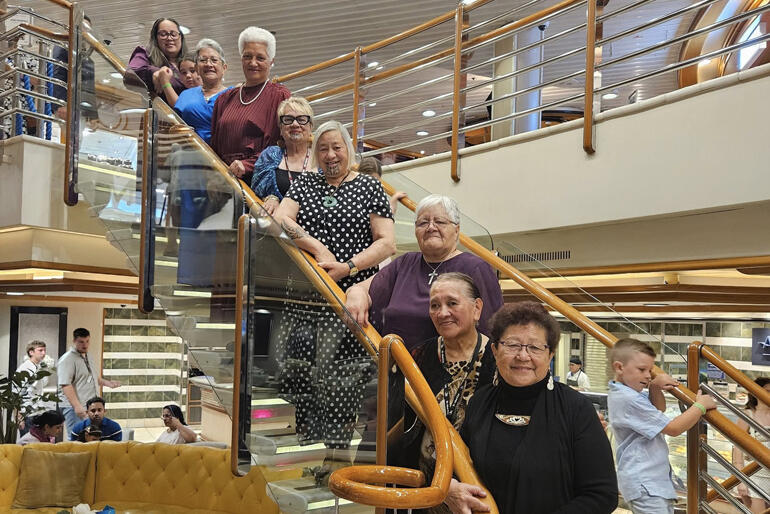
Widows are often a hidden group in church communities says Anglican deacon and nursing educator, the Rev Faye Davenport, after her post-graduate study in pastoral theology looking at how churches might understand the needs of widows better.
Despite their many biblical mentions, Faye's research into overseas sources found that often church leaders and pastoral care teams were unaware of who was widowed in their congregations and seldom understood the complexity of life changes widows are forced to negotiate.
Faye identified that losing a lifelong partner leads not only to the full-time job of grieving, but that's compounded by "secondary losses", such as loss of financial security, emotional support and loss of support for practical, technical and administrative tasks that used to be shared.
Archdeacon Mere Wallace says it was one thing talking about widowhood as a priest, and another thing altogether to live it.
"As a priest you do pastoral care, you do funerals, you go back and see people – but what I thought about it changed completely when it came to me losing someone very close."
Mere had never thought about the everyday impact of losing her beloved husband, the late Bishop of Te Waipounamu, Rt Rev Richard Wallace.
"One of the things I found was I thought that Richard didn't do much around the house, but when he went, I realised, – Oh no, I'm going to have to do all of these things myself now that he did: mow the lawn, put the rubbish out, cook, pick up the grandkids...and then there's the insurance, the electricity, the AA for the car..."
UK widow coach Karen Sutton refers to secondary losses as "suddenly having to do twice the work, but with half the labour."
Faye reports that problem came through loud and clear from the eight Manawatū widows and the two clergy she interviewed for her post graduate dissertation.
Rev Faye found the widows identified two ongoing challenges with practical tasks:
1. Unfamiliarity with the task or lack of expertise to complete it.
2. Simply needing "two pairs of hands."
One widow talked about the difficulty of staining outdoor furniture without a second person to help turn it as she went.
"Another gave the example of getting up a ladder when no one was there to ‘supervise.’ ...[so] she got up the ladder during daylight and when people were around, in case she fell and needed someone to pick her up." reported Faye.
Faye found two other factors made a positive difference to how widows could manage better as they grieved and renegotiated life without their spouse.
1. Well established relationships within the church community meant a lot.
2. Only widows understand widows.
Strong, long-term relationships within churches were a powerful source of support for widows as they navigated their lives after their partner's death.
"The strength of relationships in the church community became particularly important where family members lived at a distance, within New Zealand and overseas." reported Faye.
She also found each widow shared a strong desire to develop her independence, and it was important that she balanced that aim against receiving support from others. She says that makes it essential for churches to ask each widow what's useful at any given time, rather than setting up a "standard response".
Anglican priest the Rev Jax Clark recalls that in some ways her experience of divorce had more of the "secondary" impacts of widowhood than when her second husband died, as it had forced her to reshape life without her husband of many years.
From her experience as a widow, she believes it's vital to caution well-meaning Christians on some of the deeply unhelpful theology that came her way when her husband died. Amidst the trauma of her grief, some friends had tried to console her with spiritualised platitudes that made no sense.
"You know, some people can say some really dumb stuff to you. I remember I had a great line of things like: 'Well, there's no marriage in heaven anyway.'"
"What am I supposed to do with that?"
Rev Jax thinks it's important for the church as a whole to look hard at any distorted theology that people may share.
"I think the church has a responsibility to do the work around the assumptions and judgments we can make about divorce, and what it means to be widowed and what happens after death."
One resource Jax pointed to comes from US prosperity gospel researcher and Duke Divinity School Professor Kate Bowler, who writes on the damage of false theologies in her book, 'Everything Happens for a Reason (and Other Lies I've Loved).'
Jax says that in the depths of grief, what widows need is solidarity, not easy answers.
"So we need to be able to sit in that tension...of... 'This should never have happened.' This isn't the way I think God would have wanted it. But here we are – and it's rubbish."
"And I think learning to be able to sit in those spaces is important."
Faye found that for her group of widows aged 65+, long-term relationships in church communities had helped sustain them through the transition to widowhood and in the months that followed.
"Only widows understand what widows need." said Faye, reporting that several women talked about the value of belonging to a Widows' Support Group.
At the first meeting of one Widows’ Support Group the women had talked about how their husbands had died, because they'd found they couldn’t talk about that with anyone else. As time went on, they shared thoughts and reflections on their lives with their husbands and their week's activities.
Jax says that daily check-ins are one of the ongoing losses on the death of a spouse.
"I think sometimes you might have the practical skill to manage, but it's kind of the moral support that you miss, right? Or the shared responsibility: shared parenting, the sense of shared responsibility in the home, or in whatever you're doing."
Rev Faye found that some widows preferred contact with other widows through active involvement in the wider church community and disliked the idea of a special group.
"[I prefer to turn up] If the church is providing social engagement such as meals together, people just bowl in, widows, widowers… The integration of people with whatever giftings they bring to a church, so they feel valued, honoured, appreciated; not patronised, not ignored."
Faye asked the widows in her study to suggest ways that a church community could step up to support widows to navigate life without their spouse.
One idea was a registry, showing which people in a church community had skills in specific areas, such as plumbers, electricians, lawyers, computer specialists (retired or active) who could be there to offer tips on how widows could solve these problems.
Another idea was making sure churches intentionally provided for social and community spaces that included and valued widows without excluding them or singling them out.
Another widow liked the idea of a trouble-shooting guide.
"So if this happens.. what you need to do next is this… contact a plumber…etc So that registry [could be] a list of people with skills to give advice. They don’t need to fix the problem, but give advice on what to do or where to go next."
For more insights on the experience of widowhood you can contact Rev Faye Davenport.
Insights on navigating widowhood are plentiful from UK widow and life coach Karen Sutton on Youtube








Comments
Log in or create a user account to comment.