

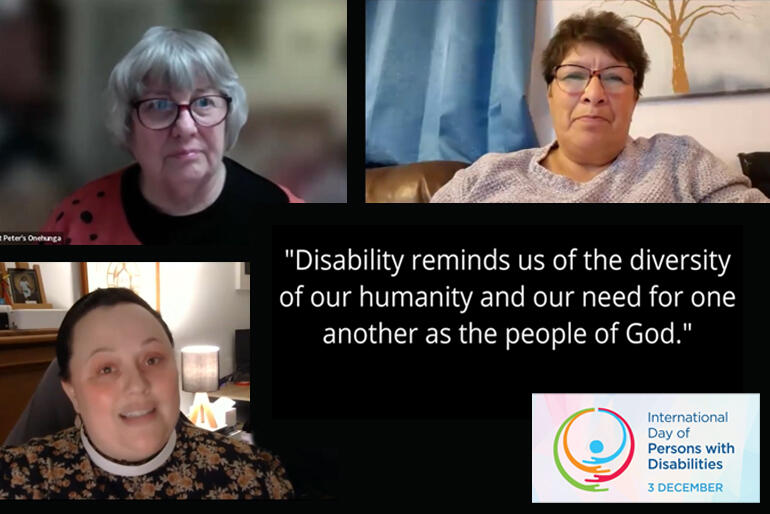
A video released by the Anglican Disability Network(ADN) for the 'International Day of Persons with Disabilities' today goes through each section of this Church's newly minted Theology of Disability, with an invitation to ponder its meaning – from the disability community to the church at large.
The Anglican Church in Aotearoa, New Zealand and Polynesia's Theology of Disability opens with an affirmation that disability is part of the human experience.
"Disabled people bear the image of God. We commit to fully include all people, that together we may become more fully the Body of Christ. Disability reminds us of the diversity of our humanity. Disabled people are full participants in the Body of Christ." it reads.
Adi Tuidama from Fiji opened ADN members' reflections with her hope that the whole church can rethink disability as a chance to learn more about God.
"Why does God allow disability when he made us in His own image?" she asked.
"Does this mean that part of God is disabled as well?"
Adi also challenged biblical misinterpretations that falsely connect disabilities with the ideas of curse, disobedience or ignorance, emphasising the presence of God's image in all.
The Rev Hilary Willett from Auckland made clear that disabled people have always contributed to the Church.
She believes too many groups still assume that people who are different are too difficult, or that they are a problem, instead of focusing on the value they bring.
In fact she suspects that more than a few prophets and spiritual heroes of the faith were "a little different."
"Saint Francis spoke to the birds. Saint Jerome irritated almost everyone he came into contact with – (and also produced the Vulgate) and Martin Luther got so upset about a theological doctrine that he brought about the Reformation."
Carolyn Tregea from Wanaka said making the effort to include diversity brings gifts to the whole church and that can lead to healing, including of disabling attitudes and misunderstandings in the community.
"That healing comes from somebody within the community going and sitting with a person and taking the time out to be with that person to actually learn something, and in doing so, gain the healing of understanding a disabled person."
Hilary said it is important to remember that not all disabilities are visible, some are social, or learning, or connected to energy levels and mental stress. While diversity speaks of the whole church, not all people face negative responses, says Hilary.
"Everyone is diverse, but some of us experience marginalization. Believe us when we tell you this, believe us when we articulate our needs, even if the costs are invisible. Don't just tell us to become more resilient."
Carolyn highlighted how important it is for people who haven't lived with disability to reflect deeply on the Church's Theology of Disability, because it can lead to a profound change of understanding.
"I look at that statement, and I think how much better off we would all be, if we lived this way. It seems to me that this is building the kingdom and living out the Gospel."
"As a group [of people with lived experience of disability] we believe that statement to be true. I think it's scripturally true."
Rev Hilary Willett summed up the video with the response the Anglican Disability Network would love to see from the Church.
"I think it is important for the church to become educated in this area, believe us, and then include us, so that the church becomes a hospitable place for us all."
• Read the full Anglican Theology of Disability here
• Watch the Theology of Disability video on Youtube here
For more information or to send in your comments and reflections on the Theology of Disability contact the Anglican Disability Ministry Educators, the Rev Vicki Terrell at resources@anglicandisability.org or Cherryl Thompson at engagement@anglicandisability.org.






Comments
Log in or create a user account to comment.