

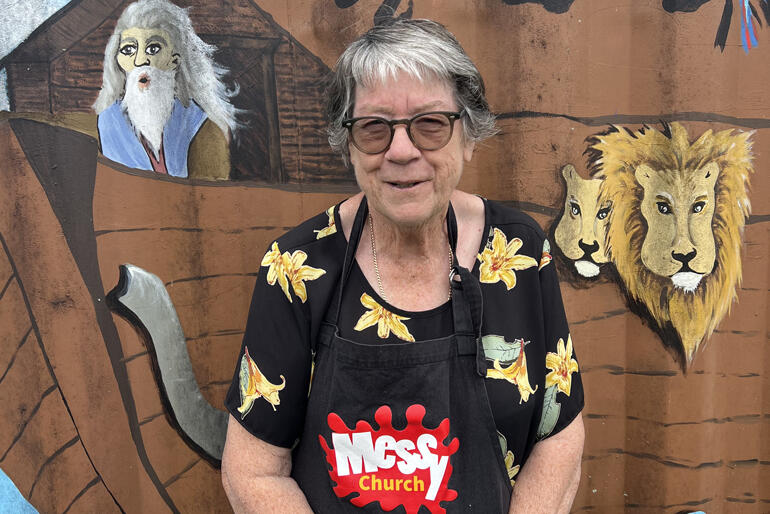
Interview with Mary Addison on 11 February 2026
Mary was brought up in Mount Maunganui. Her mum was Anglican so Mary went to Sunday School and was confirmed at 13. While at university in Auckland, attending St Paul’s Symonds Street under Archdeacon Prebble brought her into contact with the renewal movement which had a pivotal impact on her faith. Mary became a primary teacher, mainly of new entrants, and together with her teacher husband shifted to Putaruru for two years’ country service. “Forty-five years later, we are still here.” The couple brought up their four children in the town. They joined St Paul’s Co-operating Parish where Mary became part of Young Wives and Sunday School. “I’m an active member here” Mary said, with characteristic understatement. Her connection to the renewal movement continued through attendance at camps and other events. She has taught Sunday School for over 40 years: “I’m a recycled Sunday School teacher”. She also taught Bible in Schools for 20-odd years, including at Lichfield, a little country school on the way to Tokoroa where she worked for many years Mary is a licensed lay minister at St Paul’s.
Mary’s involvement with Messy Church began after she left teaching for health reasons:
The Lord laid on my heart that something with families needed to be done. I’d always thought I would do Mainly Music – preschool music – with children but when I gave up work the Baptist church opened theirs the next week!
In the meantime, Mary took exercise and music classes in rest homes.
Around that time the head of Messy Church in England, Lucy Moore, came to Aotearoa to lead some training. Mary and a few others from the parish went and were inspired. “Sometimes there’s what you want to do but God opens a different door.” Mary and her team launched their first Messy Church service in 2014.
Messy Church is an international, interdenominational way of doing church of which there are about 4000 around the world in 30 different countries. “It’s called messy because people’s lives are messy now. It’s saying to everyone, ‘Come as you are. You do not need your hat and gloves.’ I think of it as Messy Church as opposed to tidy, traditional church.”
The five core values of Messy Church are: being Christ-centred and intergenerational, creativity, hospitality and celebration.
Messy Church happens at a time when it suits the church or community. St Paul’s chose Saturday from 4 pm to roughly 6pm. There is a welcome in church for a few minutes, then people circulate round the 10 or so activity tables which are linked to the theme: “For me it’s lovely because everyone is engaged – adults, children, older people. There’s just a buzz as they move freely from one activity to the next.”
The activities are followed by a celebration time in church which lasts about 20 minutes: “a few songs, a play, a video, role play, a mini-sermon, pictures, keeping It very simple. We normally have a simple take-home message that they maybe will remember.’”
The message threads through different activities: “We have a prayer table and a prayer banner which people put their prayers up on. You might fire a prayer rocket through church.” The prayer banner changes to reflect the theme.
The Lord’s Prayer and the Grace are prayed together which leads into the meal in the church lounge at tables set with flowers or decorations and tablecloths. The hall takes any overflow.
As they are running out of room the team sets up two tables at the back of church and serve the meal from there. “They’re served on their plate whatever they want. they take it back, then sit down as a family and there’s water on the table.”
While some churches have a dedicated cook the members of the team prepare the meal: “For example, we’re having nachos this time so I’ll provide the mince and the tomato and the helpers will cook up the big dish and bring it in a crockpot. I’ll get about six of those. They bring salads and we’ll have French bread sticks or baguettes.” Dessert is usually ice cream in a cone. It’s about more than the meal: “You’re really modelling sitting at the table which some of our families don’t do. I figure that Mum or Dad’s not drinking or visually on drugs while they’re with us, and so it’s a family time.”
Between 60 and 80 people attend the Messy Church sessions at present which are run every six weeks because of the range of linked programmes that the team also offers.
As well as local families, residential mental health adults attend: “They love coming because they don’t have anywhere to look forward to go to so they’ll be asking each time, ‘When’s the next Messy Church?’”
Messy Church Cooking developed to meet a community need. “Somehow, we looked at starting a drop-in cooking class. The only people who dropped in were two or three of our residential mental health guys. We didn’t get anyone else drop in so we just started cooking every week with them. The residential mental health adults identify with Messy Church so they just call coming to cooking each week “Messy Church”. And so we became part of their programme. And they’ve got so much better.”
Mary had worked with the residential mental health adults for nearly 20 years, doing art classes once a month and cooking twice monthly. “So I’ve always had a relationship.” It isn’t simply the residents: “There’s a lot of ministry that can go to the staff. Over the years we’ve had some lovely situations and they include us as part of their whanau.”
I asked Mary how she came to be involved with the mental health residents. “A long time ago I took a friend into the padded cell at Tokanui [Hospital] and years ago I was deciding whether I returned to teaching or I went into mental health. And I’ve had family touched with mental health issues. I just love my special friends. Sometimes I take them to my house because they don’t get to go to anyone’s place for a cup of tea or social outing.”
At one of the whanau days at the residential facility, the sister of one of the attendees who previously would not come out of his bedroom said to Mary, “I can’t believe that my brother had a certificate for participation [at Messy Church]’. She was just so delighted.”
Messy School came into being three and a half years ago in response to a request to Mary from one of the Messy Church mums for help with reading. “I said, ‘Well, maybe what we could do is have a children’s group and you can be part of it, as sort of one of the helpers but you can learn alongside rather than being singled out.’” The children gave it its name, Messy School. “That told me that they identified with Messy Church. Not St Paul’s but Messy Church.” Mary describes it as a literacy support group: “It’s very limited what you can do in one hour with a range of five- to 12-year-olds. Over the time I have had to reduce my expectations”. The group was initially 20 but as the original members got older and moved on, there are currently 12 children on the roll. Mary started by teaching Jolly Phonics, along with spelling and handwriting. “They do silent reading – all the old school things.” The sessions, which last an hour, begin with a big afternoon tea. “The kids are comfortable in the lounge. It’s sort of their church.” The parents come along and have a chat. Mary wondered if the group had run its course and raised that possibility at a recent meeting. “No, the kids still want to come and the mums want them to come so…” Now the Government has brought phonics into the schools, Mary plans to do art based on literacy. There’s a team of four. In addition to Ben, a retired minister and Sarah, Mary’s part-time assistant, an 80-year-old retired teacher takes one of the girls who is struggling on a one-to-one basis.
The Messy Church team also organises Christmas gifts. When St Paul’s ran Operation Shoebox, Mary thought, “we’ve got children here that don’t have anything”. From ten shoeboxes the first year filled with essentials such as socks, toothpaste and a toothbrush, the project grew. “Last year we did about 110 big bags of brand-new gifts.”
For some of the residential mental-health adults, Messy Church gifts are the only ones they receive: “so that’s important”. The team ended up giving presents to about 70 children in the various groups or connected to them.
Last year there wasn’t enough in the account to pay for the gifts and Mary wondered whether it was time to stop this project: “It’s a lot of work right on Christmas”. As she wondered, “in came $950 into the account. Yes Lord. And then more money came and gifts came and I thought, oh we need to do this.”
Another Christmas project that originated from Messy Church UK is the sheep trail. The team places a knitted sheep in different shops round Putaruru. The shopkeeper names it and then the children go round the town in a scavenger hunt to find the names. The winner gets a prize.
Grocery boxes are the other outreach. At a function for social services in Tokoroa five years ago. Mary chatted to the woman seated next to her. “Oh, I can help you” she said, “We do food.” Via Halo, a charity in Tokoroa that distributes surplus food, Messy Church now receives groceries, initially fortnightly but now weekly. “I call it the lucky dip because you never know what you’re going to get. They also get food from the local Woolworths as well so we get lots of bread and buns.”
The outreach began for families attending Messy Church but has expanded. “They don’t even have to belong to church to get one. It’s where the Lord leads you.” About 12 to 15 parcels are distributed a week, most of which are picked up by the families, except those who don’t have a car in which case the box is delivered. We have over 30 families that receive groceries fortnightly.
The food also helps with the other Messy Church ministries: “I withdraw what will be the meat for Messy Church or baking for Messy Cooking and so that cuts our costs down a lot. That’s a real blessing.”
Mary’s husband picks up the donated food from Tokoroa then it takes two about three to hours to sort it out. “It’s quite a time commitment. But we’re just so blessed to have the groceries. We try to always be reliable and we’re always available to get them because it’s hundreds of dollars of goods that we get. We don’t say no to anything.”
When the families pick up their grocery boxes there are pastoral-care opportunities: “You can have a very relaxed conversation. So you find out who’s in jail or who’s got an ankle bracelet or whose mum is sick. It’s a really good pastoral connection.”
In the past Mary has gone, for instance to the doctor to pay for an appointment. “I don’t tend to give families cash.” She has helped some with driving licences. “Just things like that. Most of these vulnerable families don’t have full driver’s licences. Children’s camps now and then, just things that have arisen in a pastoral conversation.”
The morning I spoke with Mary she had arrived early: “We’ve just been shifting furniture. Often I’ll get offered furniture and we give it out to the families.”
There are crossovers with the different ministries:
Things dovetail. Some of my children who come to Messy School don’t come on a Sunday because Mum works. Some of the kids come on a Sunday and to Messy Church. You’re offering different layers of connection. They’ll get out of the car and help carry the groceries for their mum. It’s really about being connected. About being connected in a community.
Mary values her connections with the families very highly.
It is a big honour for me to be accepted into a Māori household. They might say, “Come and see the soup we’re making” that you’ve taught them how to make. I get blessed lots. And I might take them to Court, go to the lawyer if they don’t have an advocate, or to probation or to the doctor. Not so much now but that advocacy is what they need. They don’t have much of a voice. I’ve learned lots.
I asked Mary why she thinks she has been accepted:
I don’t really know but I try just to be alongside them. I try not to be telling them what to do. Some of the families I’ve worked with for ten years. I’ll get invited to a 21st, different things, and they’ll say, “You’re our nanny”. They don’t have extended family that are in a position to help them. And I’m not a hard sell on God. I’m not a good evangelist in terms of that …
Messy Church also connects with other agencies. Mary and her husband’s contacts with schools from their teaching careers opens doors.
I can go into the high school if I have an issue for a family and I can go into the local primary school because I taught there. And sometimes I will go to family court meetings for the family as a support person. I don’t try to solve any problems; I hand them on to the professionals. Police I know, Raukawa our local iwi. Even if I don’t know them I call them up if I think that’s where a link needs to be made.
One of the groups is Transform Aoteaora: “They run programmes such as women’s self-esteem programmes, men’s anger management – they’re a wonderful organisation. They have much the same families. I can go up and chat and say, ‘Shall we try and get so and so to come to you?’”
I asked Mary what sustains her in this work that has so many dimensions and has demanded so much of her time over so many years. On a physical level, she is very grateful to St Paul’s: “I’m really lucky in that Parish Council has employed Sarah for 20 hours a week so she’s alongside me. It’s cut down a lot of the physical work for me.” Sarah was part of the original team.
As for the emotional and spiritual sustenance, Mary is clear: “My faith in God and my philosophy. My belief is that if we trust God and we step out in faith He will always honour what we do in His name. Trust and obey.” She quotes from Micah: what does the Lord require of you but to do justice and to love kindness and to walk humbly with your God? “That’s probably who I am, between those two. And justice is a thing. I will always help the families if I feel there’s anything unjust. I’m very hot on injustice.”
Mary later told me that when she had two young children, she became very ill and was hospitalised. Coeliac’s disease was diagnosed. As she recovered, she had the strong sense that her life had been saved for a purpose. Mary had been too sick to look after her children and so knows the pain that not being able to meet the needs of children creates in a family.
I commented that Mary must encounter heartrending situations.
Well, you do question. Because I’ve been doing it for a number of years now I see the cycle being repeated with the teenagers getting into trouble and you think, am I helping? You walk alongside but that intergenerational abuse, violence, drugs, alcohol, gambling… And of course, you realise some of the parents, due to alcohol or whatever, they’re only functioning at a 12- or 13-year-old level. So you do question. But then you still do it because there’s children with hungry eyes, looking at you. My heart’s always been for the children – that’s where my heart fits.
Mary paused, then concluded: “It’s just what we do.”
I mentioned Mary’s husband’s support:
Oh yes, my husband’s very supportive. He loads the trailer and shifts the beds and goes and picks up the groceries. And cooks the tea if I’m not home. I wouldn’t have managed without my lovely husband in the background.
I asked Mary what some of the highlights have been.
I just get so many “Wow God” moments. When money just appears and I text that off to the team. To see families in Messy Church. Here’s this big strapping 15-year-old saying, “Hello Mrs Addison” and shaking my hand or giving me a hug. And I thought ooh it was a few years ago that you were … Some have come to baptism. One of our mental health adults who’s since died, I was his godmother. We would meet up town and he would say in a loud voice, “Hello godmother!” in the supermarket and I would say, “Hello godson!”. All those little things are quite a blessing.
What I love is that children don’t blink an eyelid with the mental health people. Some of the mental health adults joined a pilgrimage that Bishop David led. We held hands as we stood around the graveside and I looked around and not one young person didn’t take the hand of whoever was standing next to them. You never hear one saying, “I’m not sitting there”. And that’s really what it’s about isn’t it?
She summarised: “What I try to do is give our families more than just church on Sunday. Whether it’s a bed or a frig or whatever. And the groceries.”
I asked about the Messy Church team in Putaruru. There are over 20 members overall, some from the church, others from the community.
I’ve always figured that the Lord wouldn’t send me children and families if he wasn’t going to send me some helpers so we’ve always had enough. It attracts a variety of different people. One or two of my Messy mums have come through and they help on a table now. Or some of the big kids. We had a parishioner who came to Messy Church until he died at 90. He did the prayer table. Messy Church engages them. I think we do pretty well for a little church.
I observed that Mary frequently thanks the volunteers for what they do. She spoke about how essential it is to take care of the team. “You do need to nurture and encourage them. I’ve started having a potluck dinner with a planning meeting after. In the past we’ve had little day retreats.”
Mary talked about how Messy Church is funded.
“One of the influencing things Lucy Moore said when she came was, “Don’t charge. These people get nothing for free.’”
The team has adhered to this principle across the board: “In the 11 years we’ve been doing it, we’ve never asked for even a koha; all the programmes are all offered free.”
The work is possible thanks to a special bank account that was established as a result of Church Army evangelist Captain Peter Allfrey’s work at St Paul’s.
The account is called SEEDS: “SEEDS stands for serving, enabling, expressing, developing gifts and sharing God’s love. I remember Peter saying, “If we set SEEDS up right, it will work for the next number of years.” Which it has. All our programmes are resourced through it.
I think last year I was given $5000. Some years I’ve been given more. It just comes into the account from people when the Lord touches their heart. Some of our little congregation of maybe 20 oldies – they will slip me $50 every now and then.
A donation from a parishioner at St Andrew’s allowed the church grounds to be fenced so that the children could play safely after church: “They sent the money specifically for that.”
A relative of one of the residential mental health adults has donated very generously over the years.
In the early days, Mary applied for $500 from the Methodist “Let the Children Live” fund. “That money was used for trips – I took the families to the zoo or to pools or something. I don’t do that so much; I’m getting a bit old.”
The cost of each Messy Church is between $150 and $200.
The helpers all donate but I buy the meat and the main parts of the ingredients from the SEEDS account and any extras that for the cooking class. I have to trust God. I might get a bit tetchy when I think, oh the account’s getting a bit low, and then I have to do a double-take and sit back. And the money comes in, from different sources. I spoke at a combined church service last year and then months later I had a call from someone from one of the churches, a Gospel chapel, I think, and they said, “I’m on a trust and you fit our criteria and I’ve got $1000 to give you.” You get really blessed. Lots of “Wow God” moments. And that’s gone on for at least 12 years. It’s just a real witness to God’s provision.
The father of one of our Messy Church families that we have helped and supported is now working and he texted to say, “What’s the bank account number?” Five hundred dollars was put in.
Messy Church at St Paul’s continues to evolve: “We’re doing Communion for the first time which is a big step for us. We’ve got a service from Rev Sandy Brodine in Australia.”
Messy Church is closely associated with Bible Reading Fellowship who provides online resources for planning and an annual magazine. “We tend to just plan our own and bounce off ideas. Others completely go by the book. It does take time and it does take energy but the reward is well worth it.”
Recently St Paul’s attended a session on growing your church: “It was challenging you to do things but to do them better, for church growth. So now we will put the notices about Messy Church into the grocery bags which we didn’t do before – that communication. And it actually makes a difference.”
The team has been faithfully praying the prayer the organisers gave the parish ever since.
God of mission
who alone brings growth to your church,
send your Holy Spirit to give vision to our planning,
wisdom to our actions,
joy to our worship
and power to our witness.
Help our church to grow in numbers,
in spiritual connection to you
and in service to our local community.
Through Jesus Christ our Lord,
Amen.
“That prayer is very powerful,” Mary observed quietly.
Messy Church draws children, families and those on the margins. “We’re starting to get some baptisms come through. That’s a long journey. We have to do church differently. For me, I’d rather do it differently.”
For those wanting to know more about Messy Church
Messy Church New Zealand has resources and books and a team of about five. “I’m sort of an honorary member” Mary told me. “I turned down going on the team – I just have enough on my plate but I’m a Waikato/Bay of Plenty regional encourager. If anyone wants to learn about Messy Church, they can contact me.” Messy Church NZ offers four online master classes each year for those wanting to set it up.











Comments
Log in or create a user account to comment.