

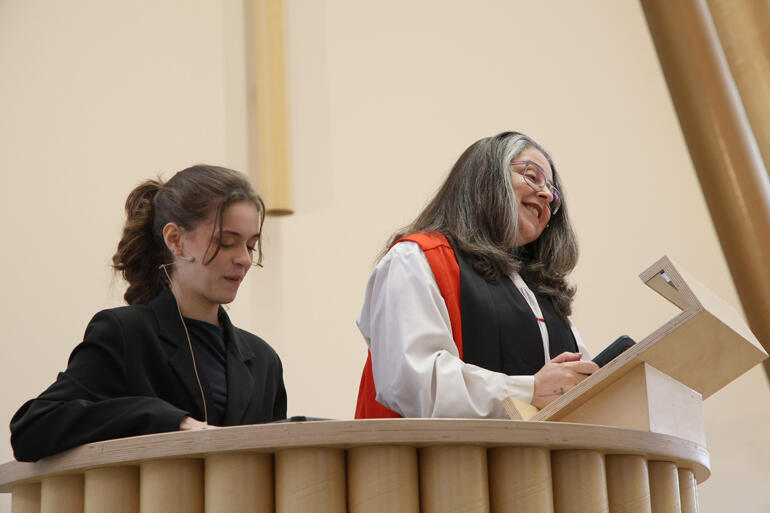
Sermon for the Ordination and Installation of Susan Hinemoa Wallace
Second Sunday after Pentecost
John 17:1-9, 18-22
6 June 2026
Dear archbishops, bishops, clergy, lay leaders, my dear sister Susan – I am very happy and deeply grateful and honoured to be here on this historic and extremely important day for the whole Church.
[Susan] Your life and ministry are gifts and blessings to the whole Anglican Communion and to the whole Church of Christ.
I come from the Amazon, and I bring with me greetings and prayers from the Anglican Episcopal Church of Brazil, the Anglican Diocese of the Amazon and the peoples of the forest. I will preach in Portuguese and Laura, my youngest daughter, will assist me with the interpretation into English.
The Tree of Life as a symbol of Christian ministry
This Celebration is full of meaning, full of elements that signal to us exactly what life is: a journey.
Reflecting on the things we shared during the retreat we’ve had over the last few days, and perhaps because I live in the Amazon, I was reminded of a powerful symbol – the tree of life.
The tree of life is a symbol that spans time and generations and is present in various cultures and religions: from the Maya to the Celts, from Buddhists to Christians, all speak of the symbol of a great tree, which unites belief, philosophy and spirituality.
In the Amazon there is a tree called the Samauma. The Samauma is an ancient tree. It stands between 80 and 90 metres tall and can reach a diameter of 5 to 8 metres. In its mature stage, it takes a circle of more than 25 people holding hands to encircle it. It can take between 200 and 300 years to reach maturity.
The ‘mother’ samaúma (as it is called in the Amazon) is considered a sacred tree by the forest’s indigenous peoples. Its importance is vital to the environment. It is regarded as the tree of life, the mother tree of the Amazon. It is the matriarch of a perfect ecosystem.
In Celtic mythology, for example, there is a great tree with roots that cover the entire ground and leaves that reach the sky, representing the interconnection between all things in the universe, a bond that is both physical and spiritual.
This Celtic image found a home in Christian tradition, because according to Jewish and Christian traditions, the Tree of the Knowledge of Good and Evil, which was planted in the centre of the Garden of Eden, is a key element in understanding the story of creation. An element that symbolised the wisdom of God the Creator himself.
Despite their different meanings, trees have always been seen as sacred symbols of vitality, connection and wisdom. Similarly, the concept of ancestry is closely associated with the image of trees – we use the term ‘family tree’ to describe our origins.
Deep roots that connect us to the past, a tangle of branches that continue to grow and give life to new fruits (new generations).
Moreover, just like trees, we are made up of cycles of life. And through these many cycles, from the Forest to the Ocean – life has brought us to this moment. Today is a time for anamnesis – that is, a time to remember, not merely to look back at the past, but to bring it to life in the present.
Vestments and ministry symbols connect with faith passed down
In this ceremony, from the vestments you will wear to other important symbols, we are reminded of those who preceded you in the faith, and among them, your father.
I am very fond of the Celtic saying that goes: ‘Memory is the heart of hope’ – we gather here today, steeped in memories of the past, but also driven by the experiences of the present.
And here we are today to thank the Lord for your life, Susan, and for your ministry, for your calling as a bishop/pastor, as a woman chosen for the task of shepherding Christ’s flock.
Bishops are called to service, mission and prophetic witness
From the earliest days of the early Church, there was already an incipient doctrine of ministry. This doctrine was related much more to charisms than to positions or hierarchies.
The New Testament idea of ministry has its origin in the example of Jesus himself who, in a demonstration of love, presents himself as “the one who serves” (Lk 22:27) and who came, “not to be served, but to serve” (Mt 20:28).
“The Church, as the Body of Christ, shares his life and has ministries derived from Christ himself” – that is to say, Christ is the model of ministry in the Church. All authority is derived from Christ and exercised in submission to him.
From the very beginning of the Church, Jesus has also been identified as a prophet. To be a prophet implies a willingness to confront injustices.
Just as Christ was sent by God, so too does He send us. To be sent (as an apostle) is to take on a prophetic role. From this we deduce that the apostles and their successors are also called to exercise a prophetic role in this world and to continue the mission that Jesus entrusted to them.
It is important to emphasise that there is no human merit in being called to exercise the ordained ministry in the Church. It is God who calls us and who empowers us. The entire life of the ordained minister is lived in service to God and to one’s neighbour.
Ministry, whether episcopal, presbyteral or diaconal, is not an honour, but a call to service, to mission, to evangelisation and to prophetic action ‘in the name of God and for the sake of the people’.
Bishops remain human and must rely on God
To be a pastor or bishop is, first and foremost, to be human.
We are ordinary people, with limitations and with qualities (John 17:6). That is who we are. And however much we might wish it, ordination does not immunise us from human weaknesses and errors – in other words, we are not perfect. On the other hand, our weaknesses do not invalidate or hinder God’s grace. In other words, our frailties do not prevent Christ from acting.
A bishop is a shepherd; she has the task of being a teacher of the faith and a witness to the truth. She must devote herself to the most vulnerable, to the liberation from injustice, be a sign of the inclusion and welcome that comes from God, and be a servant to all.
The episcopal ministry is sustained by God’s mercy to inspire the ministries of all Christians. It is a life that harmonises with great responsibilities, enormous commitments, many sacrifices, and also great joys.
We can affirm that our ministry must come from the heart of God to be at the heart of the world, as a presence of God’s love. To be a pastor/bishop is to be a kind of ‘midwife’ to new life in Christ.
Christian vocation is "being sent out" & "being one"
And in light of this, I wish to refer to the Gospel text chosen for today’s celebration, a text that resonates with the vocation of each of us: ‘Just as you sent me into the world, so I send them into the world’ (John 17:18).
And: I do not ask only for these, but also for those who will believe in me through their word, so that they may be one… as we are one… (John 17:21–22).
This morning’s Gospel is part of Jesus’ high priestly prayer. A prayer he offered shortly before his passion and death. It is a call, an invitation to unity in love, and also a reminder that our ministries must be exercised in collegiality, together.
As we take up our ministries – both ordained and lay – we must remember that we are intrinsically linked to Christ – but we are also linked to one another in love.
This is a statement that once again brings to mind images of trees. Although in a forest there is distance and space between the treetops to allow the passage of the sun, the winds and the rain, their roots are completely intertwined; there is an underground web that keeps the whole forest connected.
Susan, my dear sister – shortly, kneeling before God, before your people, before your colleagues in ministry, you will receive the laying on of hands from all those with whom you have shared the journey in the episcopal ministry, and the anointing of the Holy Spirit for the mission of shepherding God’s people.
Episcopal ministry calls for reconciliation and care
The ministry you are taking on is no easy task; you will need to reflect deeply before acting, be mindful that you are part of a body, and have the discernment to lead the people God has placed under your care.
You will need to be a sign of reconciliation among God’s people. To be an example of love and care, to be a person who listens and respects.
You are called to be a sign of the Church’s unity, a builder of bridges, and someone who makes Christ’s presence visible. But also a prophetic voice in the face of injustice.
I know the journey is not easy. I see in you a disciple who, with all her strength, lives out her ‘yes’ to Jesus’ call. I see in you openness, willingness, passion and courage.
Therefore, my dear sister, my prayer on this special day is that you may never lose sight of the fact that your vocation is God’s plan; it was God who chose you, prepared you and today consecrates you, through the Church, through our hands – for the exercise of the episcopal ministry;
Susan, as a Maori woman, a child of this land and this ocean, you have an important role to play in the current landscape of the Church and the world. I am certain that you bring a different perspective, a different sensibility and a different approach. You have already been exercising, and will continue to exercise, the ministry to which you have been called by God – in your own unique way.
May Christ always be visible in your ministry. And may the Holy Spirit of God strengthen, bless and protect you, and grant you health, courage, joy and perseverance. We are grateful to God for your life and ministry. We are grateful to God for your ‘yes’.
Amen.










Comments
Log in or create a user account to comment.