


The Buck Stops Here.
That was the sign that US President Harry Truman kept on his desk during his term in office.
When it came to making the tough decisions, it said, he wouldn’t shirk responsibility.
The Bash Stops Here.
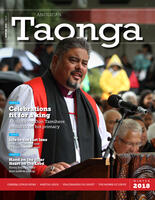
On Sunday, in Suva’s Holy Trinity Cathedral, Archbishop Winston Halapua demonstrated that he’d also take responsibility.
He'll do whatever he can to end violence against women and children on his turf.
And he used his cathedral, the traditional teaching seat of a bishop, to publicly say (in effect)...
We’ll start with ourselves.
As the Diocese of Polynesia, we’llbegin the work of cleaning house.
We’ll end the violence in our own families, and in the structures and processes of our church – and then we'll take this message further afield.
During last year’s International Anglican Family Network gathering in Lower Hutt, Dr Halapua had said he was keen to take a lead on confronting family violence in his diocese.
At Sunday's main cathedral service, he underlined his commitment to doing so.
Before the Gospel was read, for example, the Cathedral Men’s Group processed from the back of the cathedral down the centre aisle, where they unveiled a new banner that declares their commitment to ending violence.
That banner stands, unfurled, for all to see, on the mezzanine which overlooks the altar.
And that banner's message was reinforced in the sermon of the Rev Dr Feleterika Nokise, the Principal of Pacific Theological College, who spoke of the impossibility of the Christian being able to help others and reflect Christ if he “is not a safe person.”
Both Dr Nokise and his wife, Rev Rosalyn Nokise (who is on the cathedral ministry team), have worked at Lower Hutt’s Family Centre, which is at the forefront of grappling with family violence in New Zealand.
Senior figures from Fiji’s police and social welfare departments had already made private approaches to Dr Halapua about the problem – and those same officials and their co-workers were on hand in the cathedral to watch the diocese’s Elimination of Violence programme being unveiled.
Archbishop Halapua announced that the Dean of the Cathedral, the Very Rev Fereimi Cama, had agreed to take up the challenge of rolling out Elimination of Violence training throughout the four countries of the diocese.
The idea is to “train the trainers” first, and the clergy from the Suva/Ovalau Archdeaconry will gather next week for the first of these sessions.
This will include input from a representative of the Fiji Women’s Crisis Centre, and from Dr Fele and Rosalyn Nokise, who will draw on their years of experience in anti-violence work in New Zealand and Fiji.
Dean Cama says violence “is a significant problem in most areas of the Pacific.
“Most of the NGOs,” he adds, “have been talking about it for a long, long time.
“And the question that I’ve been asking is: ‘What has the church been doing about this? What has the church been saying?'
“This is an issue that has to be talked about, and preached about, in all our parishes.”
And the preaching started with Dr Nokise’s Sunday sermon:
“For the diocese to embark on this project,” he said, “we need to begin with ourselves.”
“We need to look at our own lives, and check whether we are violence-free, and whether we are safe people to help others.
“We have been given a promise in the Scriptures that we belong to Christ. Our identity is that we are children of God, made in God’s image – and therefore we are called to reflect God’s ways, which are based on righteousness, justice and love."
Dr Nokoise said that many people have “violent tendencies” within their characters, and it can be “a huge challenge and painful struggle” to examine and address those traits in the light of the gospel message.
He said Pacific Island culture had often emphasized a harsh view of discipline and this had become tangled up with men’s view of themselves.
That view, in turn, was wrapped up with concepts of power, control and authority.
“But often, these things are not in line with the gospels.
“If we are to produce life, and to give life to others, we need to look at these concepts and what they mean to us.”
Dr Nokise said the oft-quoted Old Testament justification for smacking children, “Spare the rod and spoil the child,” was not an excuse for violence against children.
He outlined various alternatives to disciplining children.
“Often you don’t realise the force of a so-called ‘slap’ on a child.
“I’m not sure whether the child learns any lesson – except how to be afraid.”


Comments
Log in or create a user account to comment.