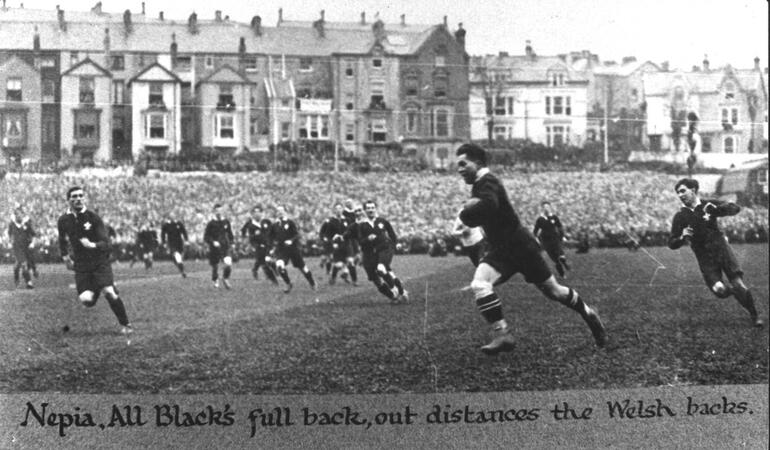
As a 19-year-old, George Nepia was a member of the 1924-25 All Black team that played 30 matches on the trot in Britain, France and Canada.
They won the lot, and earned the title: “The Invincibles”.
George Nepia played in every one of those matches. Twenty-five years later, one English sports writer wrote: “…It is not for me a question of whether Nepia was the best full-back in history. It is a question as to which of the others is fit to loose the laces of his boots.”
George, who was born at Nuhaka and had Ngati Rakaipaaka ties, became hot property after that tour – and that explains why, in 1925, he was asked to play in a match to mark the opening of St Mary’s Church, Tikitiki.
That’s where he met Te Huinga Kohere, a local school teacher who was tinkling the ivories at the post-match dance that night. For those two, it was love at first sight.
And when George wed Huinga, he also married into St John’s Church. Here’s how that works:
Huinga’s dad was Henare Kohere: Lieutenant Henare Kohere, who’d fought with the Pioneer Battalion, and died on the Somme. Henare was the brother of Poihipi Kohere, the vicar who kept the fires burning at St John’s for all those years.
And Huinga’s mum, Ngarangi, was the daughter of the Rev Mohi Turei, who’d driven the building of that church.
And Huinga herself? She taught Sunday School and played the organ at St Johns.
Anyway. Back to George and Huinga. They knew they were right for each other, but they had to wait. Huinga’s family wanted to cast around for other matrimonial options.
In the end, they say Apirana Ngata and his wife stepped in, gave the couple their blessing – and George and Huinga’s marriage took place at St Mary’s, Tikitiki, in May, 1926. It was the first wedding in that newly-carved church.
Huinga’s family gave the newlywed couple some land at Rangitukia, and George’s dad gave them a few cows. When he wasn’t playing rugby, George milked that herd, and toiled away clearing gorse.
Ironically, George never shone as brightly as a player again – apartheid (he wasn’t considered for the 1928 tour of South Africa), injury, the Depression (George played league in the UK to feed his family during those grim years) and the Second World War saw to that.
Even so, George and Huinga’s second son, Te Omanga, says his parents very happy in the Waiapu valley.
They were big contributors round those parts, and they were active in their church. Te Huinga, especially, of course. But George too – he doted on Te Huinga, and anything she did, he supported. Hone Kaa remembers him taking up the offertory, Sunday by Sunday.
But when the butter factory in Ruatoria closed in the early 1950s, you just couldn’t make a go of things on those small Waiapu Valley dairy farms any longer. George and Huinga shifted to Wairoa, where he worked as a farm manager. Later George did a stint in a factory in Masterton, where his daughter was living.
In his old age, new honours came to George. In 1982 he was invited to Wales with the New Zealand Maori team – and was greeted at the St Helen’s ground at Swansea with a spontaneous, sustained, standing ovation. His heroics on that paddock more than 50 years earlier were legendary in those parts.
Huinga died in 1975. She was laid to rest in the urupa at St John’s – and in August 1986, George was laid to rest beside her.


Comments
Log in or create a user account to comment.